






Kurt Hummeldorf, DMD-PC

When Should You Consider Dental Implants?

Lady smiling with implantYou may have heard in the past that dental implants are one of the most effective ways to replace missing or damaged teeth. Dental implants are a great option for a lot of different situations, but when is getting a dental implant the best option for you? There are a few circumstances where receiving an implant might be the best option for improving your smile.

Dental implants typically consist of three components: the post, the abutment, and the restoration. The post is a screw which is inserted into the bone. The abutment is attached to the post and the restoration is placed on top, giving the finished product a beautiful, realistic look.

To restore and preserve your appearance.

One of the main functions of dental implants is to restore a smile back to its original glory. They are built to last a lifetime and last much longer than dental bridges. If you are looking for a permanent solution to damaged or missing teeth, dental implants are your best option.

To protect and preserve a healthy jawbone.

Missing spaces in your smile can lead your jawbone to deterioration, which causes it to lose its strength. Dental implants are the only option which will protect and save your natural bone. Waiting to get a dental implant can continue to increase the chances of your jawbone not being able to support dental implants in the future.

To stop your teeth from shifting.

Losing a tooth can cause the surrounding teeth to shift and look unnatural. These teeth can become crowded or can be shifted unevenly. This can cause your teeth to become harder to clean and can also cause your face to sag and appear sunken.

These are just a few of the instances in which you should consider getting dental implants. Dental implants are one of the most useful and successful restoration options available today. For more information on how we can restore your smile with dental implants, contact Kurt Hummeldorf, DMD-PC at San Diego Office Phone Number 619-282-7088 today.


How to Take Care of Your Dental Implant

'man flossing teeth'Cleaning and taking care of your implant is just as important as cleaning your natural teeth. Here are some things you should know about caring for your implant.

Your implant and your natural teeth are similar because they both rely on healthy tissue for support and both can build up plaque. It’s important to remove that plaque because it can develop into an infection. If the infection isn’t properly treated, it can result in a loss of bone around the implant which could progress to the loss of the implant itself.

It’s important to get your teeth cleaned on a regular basis so your dental hygienist can get that biofilm off your teeth and keep your teeth infection-free. As always, you should be brushing your teeth and flossing twice a day. Never use your teeth, especially your implant as “scissors” to open anything.

Dental implants are the closest thing you can get to real and natural teeth. They don’t require any special products or treatment. Just a simple brush and floss will do the job. They are also long lasting. If they are properly cared for, they can last a lifetime, avoiding any further dental work down the road.

With a dental implant, you can still enjoy all your favorite foods. It will not loosen or fall out if you are chewing something hard.

Overall, dental implants are meant to make life better and easier, not to add issues or interrupt your life. You don’t have to go out of your way to take care of them – a simple brush and floss will ensure that they improve your overall quality of life for many years to come.

If you think a dental implant may be right for you, call Kurt Hummeldorf, DMD-PC at 619-282-7088 to schedule a consultation with us.


New Trends in Dental Implants

'dental implants'New Trends In Dental Implants

A trending topic right now seems to be the decision to opt for “mini-dental implants” instead of more traditional ones. Below we are going to take a look inside the trend, and lay out some of the benefits and drawbacks so that you can get a better understanding of this exciting trend in dentistry.

Benefits

  • Mini dental implants are usually less expensive than traditional ones, sometimes costing only 1/3 that of regular implants. They take less time to place and are smaller and less invasive, and can be used in small spaces or for those with inadequate bone mass.
  • With mini dentures, smaller dentures can be used, leading to a better tasting experience for the palate than a traditional denture would provide.
  • Mini implants can be placed with minimal recovery time, and usually require very little to no bone grafting.

Drawbacks

Because this is still a fairly new procedure, there are a few downsides. For one, there aren’t enough studies out there on the longevity of these implants, so we don’t know how they hold up over time. A study published in the International Journal of Implant Dentistry in 2016 revealed that traditional dental implant placement has a proven survival rate of 95% or greater. The analysis collected data from over 10,000 implants from 3,095 patients, across three separate private practices over the course of 20 years. For mini dental implants, there isn’t yet enough data to conclude a proper survival rate.

Another concern is that because this is such a new trend there is not as much information or regulation out there. Some practices with claims such as “Dentures-in-a-day” might not do a proper consultation, skipping important steps such as a 3D scan to make sure that you are a good candidate for the procedure.

While it may be some time before this method is perfected and adopted, it is also exciting to see the advancements changing people’s lives in the dental industry every day. Check in with Kurt Hummeldorf, DMD-PC to find out what tooth replacement options may be right for you!


Orthognathic Surgery

'woman smiling in dentist chair'What is orthognathic surgery?

Also known as corrective jaw surgery, patients undergo this procedure in order to correct a wide range of major and minor dental and skeletal irregularities. Jaw surgery is used to correct the misalignment of a person’s jaw or teeth, which will eventually improve breathing, chewing, and speaking. While a patient’s physical appearance may be altered just a bit with surgery, orthognathic surgery is mostly meant to correct functional problems.

What are some conditions that require orthognathic surgery?

There are quite a few conditions that indicate that you may need jaw surgery. Some of those include:

  • Sleep Apnea (breathing problems during sleep)
  • Protruding jaw
  • Open bite (someone who is unable to fully close their mouth)
  • Chronic mouth breathing and dry mouth
  • Difficult biting food or chewing
  • Difficulty swallowing
  • Chronic joint or jaw pain (TMJ)
  • Excessive wear on teeth

Evaluating Your Need For Jaw Surgery

We will work with your orthodontist and general dentist to evaluate your need for jaw surgery. In a great number of cases, patients need to have orthodontic work done before and after surgery. Jaw surgery is a lengthy and delicate process. In most cases, the whole process, including orthodontic work, will last 1-2 years. We will evaluate you thoroughly and realistically so that you may make the most informed decision possible.

How will I benefit from having jaw surgery?

Corrective jaw surgery will benefit you in numerous ways. After surgery, your jaw will be more aligned and balanced, and you will have more a far more functional and healthy jaw. While recovery may be lengthy, we will keep you comfortable along the way. With jaw surgery, patients can see an improvement in speech, eating, chewing and also breathing. Many patients see a positive change in their facial structures aw well after their jaw has been realigned.

To find out if you are a good candidate for corrective jaw surgery, please call us at San Diego Office Phone Number 619-282-7088.


Tooth Extraction – Managing Pain

The Procedure Itself
Thanks to a wide variety of anesthesia choices available to us these days, you should feel no pain during your extraction.

After the Surgery

  • Over-the-Counter Medicines: Generally speaking, over the counter non-steroidal anti-inflammatory medications such as Ibuprofen are all that you will need following your surgery.
  • Staying On Top of Pain: It is very important to stay on a strict schedule of medication the first few days following your surgery. Getting behind on medication will result in more pain and may even make it difficult to catch up with pain control again.
  • Ice for Swelling: We want you to ice your cheeks for the first 24 hours following surgery, twenty minutes on and twenty minutes off alternating. Managing swelling can help greatly with pain management, and the act of icing may even feel good on its own.
  • Rest: Your body was expertly designed with high-tech systems in place to heal – but you have to give it the space and conditions to do so. Rest is one of the most important things you can do to help your body heal faster.
  • Salt Rinse the DAY AFTER Surgery: The day after surgery, you should rinse your mouth very gently with a mixture of one cup of warm water and ½ teaspoon of salt. You may do so up to 4 times a day. Designed to gently clean the wound site (but NOT dislodge the blood clot), some patients also feel that the warm water helps with pain relief.
  • Prescriptions: Most often, our patients do not require prescription pain medication post-op. However, in the case that we feel your case calls for such, please keep the following in mind:
    • Antibiotics – If we have ordered antibiotics for you, you must take them on schedule and for as long as we prescribe – Never stop antibiotic treatment prematurely without our specific orders.
    • Pain-Killers – In the event that you require prescription pain killers, please note that we are required to prescribe these sparingly and in accordance with certain laws, due to rising rates of substance abuse. You can help keep these drugs off the street by taking only what you need, and taking unused pills to a pharmacy for safe disposal – never “keep them around” in your cabinet for future use.

For more information, please visit our surgical instructions page and feel free to call us at San Diego Office Phone Number 619-282-7088


Where do Dental Implants Come From?

kid studyingDental implants have a surprisingly rich and interesting history. Across centuries and throughout cultures around the world there is evidence of attempts at replacing missing teeth with various objects and materials.

The oldest dental implants can be traced back to 2000 BC in China, where missing teeth were substituted with bamboo pegs.

Fast forward a bit to around 1000 BC and you’ll find an ancient Egyptian King whose tomb was recently discovered along with his mummified remains; a copper peg hammered into place where a tooth once lived. This may have been the first time in history that we know of when metal implants were used.

Across the globe some time around 300 BC, an iron tooth was found in a French grave thought to be Celtic in origin. It is possible this implant may have been a post-mortem placement to honor the dead, as an attempt to perform the surgery using a live patient would have been an excruciatingly painful process.

Just 2000 years ago missing teeth were being substituted for animal teeth, and the poor were even selling their teeth to the wealthy, just to make ends meet! The body often rejected these surrogate teeth, causing infection.

More recently in 1931 in Honduras, Dr. Wilson Monroe and his wife found a jawbone amongst other artifacts, with teeth fashioned from shells and attached to the jawbone of an ancient man.

Today we are lucky enough to have dental implants that not only look and feel like real teeth, and anesthesia for the pain is also a plus. Thanks to studies conducted by Per-Ingvar Brånemark of Sweden in the 1950’s, oral surgeons have been able to perfect the process over the years to create today’s implants, which have a 98% success rate! Through a process known as osseointegration, metals and other implant materials are able to be skillfully placed so that your jaw bone actually attaches itself to the implant creating a seamless support system.

Missing a tooth or two? Give us a call at San Diego Office Phone Number 619-282-7088 to discuss your dental implant options today!


Impacted

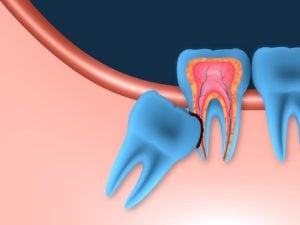
impacted wisdom toothWhen you hear this word in our office, it is most likely that we are talking about your wisdom teeth. And while we know that it may sound scary to have “impacted wisdom teeth”, we want you to know that, actually, it is very common.
What are impacted wisdom teeth?
Throughout evolutionary history, human mouths (jaws) have become increasingly smaller. While the jaws have gotten smaller, the amount of teeth we have has not. So now we have the same amount of teeth squeezing into a smaller space. Because wisdom teeth are the last to erupt, they often become impacted – that is, blocked by the other teeth around them. Often they are growing in sideways or unable to erupt through the gums at all due to crowding.

Why do wisdom teeth need removal?
The inability to erupt properly means that wisdom teeth can cause a lot of pain and even become infected down the road. This is the main reason that we recommend the removal of all third molars (another name for wisdom teeth). The reason that we remove them during the teen years is that the bone is still soft and recovery from the surgery is taken by the patient much better at this age. If we were to wait, your teeth may become infected, your bite crooked, and it may be too late at some point for us to take them out.

Types of Impaction:

  • Vertical Impaction – In this case, the tooth is unable to break through the gum line. Vertical impaction is very common.
  • Mesioangular Impaction – Angled toward the front of the mouth, the tooth is probably pushing on its neighbor, causing pain and crowding. This type of impaction is also very common.
  • Distoangular Impaction – This tooth is angled toward the rear of the mouth, it is uncommon.
  • Horizontal Impaction – In this case, the tooth is a complete 90 degrees from where it should be, and is likely growing into the roots of its neighboring tooth. This is very rare.

What is the removal procedure like?
You will be completely pain-free during the surgery, which takes just about an hour. You will also be sent home with instructions for pain management, eating and rest orders.

What is recovery like?
You will recover comfortably at home. You can start drinking liquids and soft foods as soon as you feel ready, but should avoid crunchy foods, extra hot or cold items, and straws (NO STRAWS!). You can expect to resume some of your normal activities a few days post-operation.

If you have any questions about wisdom teeth removal or aren’t sure if you even need the procedure, give us a call at San Diego Office Phone Number 619-282-7088!


3D Printers and Bone Grafting

3d bone graftThere is exciting news in bone grafting technology that will hopefully find its way into the oral surgeon’s office over the next decade! Researchers have been able to create a synthetic bone material using 3D printers that may be better than what is being used now.

3D printers create three-dimensional objects out of a variety of materials using a computer as a precise guide. Although the concept has been in the news a lot recently, the practice actually dates back to before the 21st century. In fact, 3d printing’s roots go back to the early 1980s. Since then, everything from jewelry to synthetic human organs has been printed, much to the amazement of modern society!

And now, surgeons have successfully implanted the 3D-printed synthetic bone grafting material into animals with bone defects. This “hyperelastic bone” was made using just the right combination of bioactive materials and polymers to make a material that could be layered while still wet, allowing for better adherence between layers.

Here are some of the expected benefits of this new material:

  • Very elastic, allowing for cutting without crumbling, which can be a problem with current grafting materials.
  • Blood vessels move in quickly because the material is porous.
  • Biodegradable as the body replaces it with genuine tissue.
  • Doesn’t dry out right away.
  • So far the animals haven’t rejected the implant, which could mean less complications for humans as well.
  • Could be a great option for children since it will grow with them.

While human trials are potentially five or more years away, the news is very exciting for the surgical community, and we are can’t wait to see what benefits this will bring to our patients.

To find out more about bone grafting in general or to set up a consultation with our office, please call us at San Diego Office Phone Number 619-282-7088.


Missing Teeth: More than Just a Gap in Your Smile

man smilingWhile it is true that the most obvious effect of missing teeth is a gap in your smile, missing teeth can cause other problems that you might not be immediately aware of. For example, did you know that for every missing tooth you have you lose 10 percent of your chewing ability? Read on to get a better idea of how a missing tooth can affect your life.

Surrounding Teeth
A missing tooth usually means more stress for the remaining teeth. In addition to that, if you are missing a tooth on the lower jaw, the opposing tooth on the top can grow longer to fill the gap in a process known as superuption or extrusion. This could lead to teeth tilting and move out of place by drifting into the space that was left by your missing tooth – a disaster for your beautiful smile!

Digestive Health
If you are missing teeth, you can’t enjoy all of the foods that you are used to eating – bad for your health and bad for your mood! Say goodbye to caramel apples, saltwater taffy, crunchy carrots and even gum. And because the variety in your diet is reduced when a tooth is missing, digestive problems are unfortunate yet common.

Decay and Hygiene Problems
The shifting of your teeth may cause new hygiene issues as it may be difficult to brush and floss like you normally would. This leaves your mouth more vulnerable to gum disease and tooth decay.

Facial Aesthetics
People with more than one missing tooth may also have issues with a collapsed bite which causes a loss of vertical dimension. This could make your face appear shorter, as the distance between the tip of your nose and your chin would decrease.

The good news is that you don’t have to suffer anymore! Dental implants can help you avoid all of the problems listed above and let you live your life normally again. It’s never too late for a dental implant, give us a call at San Diego Office Phone Number 619-282-7088 to find out about this life-changing procedure.


Immunotherapy and Oral Cancer

You may have heard: Immunotherapy is proving to be very promising in the treatment of a variety of , in particular lung cancer and advanced melanoma. However, immunotherapy has not found its way (yet!) into the treatment regimen for head and neck cancers.

What is immunotherapy?

Immunotherapy is the process of enlisting the patient’s own immune system in the fight against cancer cells. Sevewoman staringral drugs have been used successfully to aid in the treatment of advanced lung cancers and melanoma, giving patients a longer prognosis in many cases.

Cancer Cells are Tricky

Cancer cells are notoriously sneaky – their ability to hide from immune cells is one of the reasons that cancer is so hard to treat. This is where “checkpoint inhibitors”, one of the most common classes of immunotherapy drugs in cancer treatment, come in. These drugs help to block the activation of proteins that help cancer cells hide from immune cells.

The Connection with Oral Cancer

Recurring head and neck cancers are very difficult to treat. Often they are resistant to the best chemotherapy drugs, so the hope has always been that immunotherapy drugs may some day step in to assist with the oral pathology fight. A recent trial in the UK has shown that the day may be coming sooner than we thought! The trial proved successful in extending prognosis for many of the patients.

Reduced Side Effects

The research also noted that side effects were reduced to give patients a better quality of life during treatment.

More Testing Needed

While more research is needed before the drugs receive FDA approval for the treatment of oral cancer, the good news is that because these drugs are already approved and on the market for other cancers, the application process for use in oral cancers will be quicker (and smoother) than it would be for a new drug.

At Kurt Hummeldorf, DMD-PC, our commitment to your care, comfort, health and safety is evident from the minute you walk through our door. Call us at San Diego Office Phone Number 619-282-7088 for more information about oral cancer.